The System Grew Up: Norn, ForgeWorx, and What Happens When a Workflow Proves Itself
On 27 May 2026 at 0925 I wrote five words in my notebook:
generated task list in Claude.
That was it.
No project. No roadmap. No grand design. Just a Tuesday morning with too many loose threads and a five-minute attempt to stop dropping things.
I was not trying to build a productivity system.
I was trying to build enough structure that my brain did not have to keep carrying everything.
That five-word note became Atlas and Mimir. Those became the foundation of Norn.
Three weeks later, the workflow had proved useful enough to create a different question:
Could the architecture survive if I removed myself from it?
This is how that happened.
The first proof was not the app
The first proof was the notebook.
My Skilcraft steno has a physical index now. One paperclip marks where I am. I rarely need to move more than a few pages to find the things that matter: circles that need carrying forward, decisions that need recording, ideas that need somewhere to live.
Those things end up where they belong: still visible on the current page, in Atlas, in Mimir, or scheduled on the calendar with a notification attached.
The paperclip moves through the notebook in sync with what is live in Atlas.
That sounds like a small thing.
It is not.
When physical and digital stay synchronized without extra effort, the system has stopped fighting the workflow.
The notebook is not behind the app. The app is not replacing the notebook. They are the same signal in two different forms.
The notebook is still the cockpit. The app is what gives it memory and structure after the fact.
The second proof was that I stopped losing things.
Not because the system became perfect. Because when something did fall through, I could see where it fell.
Atlas showed me blocked work. Mimir showed me stale context. The dependency layer showed me what was actually waiting on what.
That visibility changed how I plan, not just how I track.
The third proof was quieter.
By the time I was ready to release ForgeWorx, I had stopped opening Atlas on a desktop entirely. The app became the daily driver. It lived in my pocket. I touched it throughout the day.
Bulk changes happened through export and import when needed. Everything else happened on the phone.
The tool had crossed a line.
I was no longer maintaining it.
I was using it.
The task count grew because I captured work accurately.
The completion count grew because the system kept surfacing what was actually actionable.
Both moving in the right direction at the same time was the proof.
Norn was the laboratory
On 16 June at 2301 I wrote ForgeWorx in my notebook for the first time.
Not as a product.
As a question.
Generalized productivity bundle, based on Atlas, Mimir, and Fountain. TekForge via GitHub for free.
That was the whole plan.
The next morning I started building it.
What I had already built was working. The question was whether the architecture underneath it was worth sharing, or whether it only worked because it was tuned specifically to me.
The answer was yes.
But not exactly as it existed.
Norn is my personal operations shell. It is not a productivity app. It is an operational system built around the way I actually work.
What started as three tools has grown into six:
- Atlas — committed action and execution.
- Mimir — memory, decisions, and durable context.
- Fountain — health and physical-state history.
- Shop — procurement before purchase.
- Vault — owned inventory and asset lifecycle.
- Ledger — actual financial inflow and outflow.
Everything is static HTML, local-first, and deployable without a subscription.
Norn works because it is deeply personal.
That is exactly why it cannot be what I release.
ForgeWorx is the pattern without the person
The mistake would be thinking ForgeWorx is a smaller version of Norn.
It is not.
Norn is the laboratory.
ForgeWorx is the result after removing the operator-specific pieces.
The thing worth sharing is not my categories, naming conventions, or infrastructure context.
It is the architecture underneath.
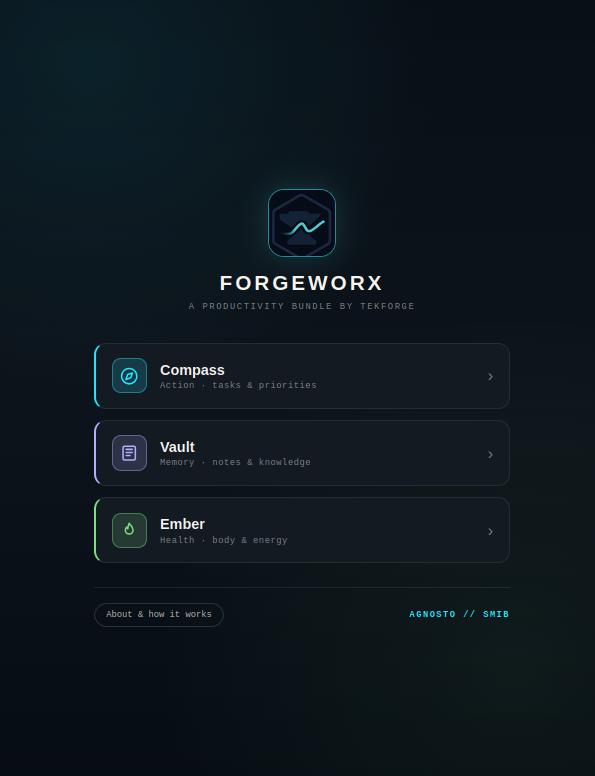
Three layers. Clear boundaries. Local-first. No server required. Import and export from day one. Static HTML that can be opened in any browser and deployed anywhere.
The boring architecture is the feature.
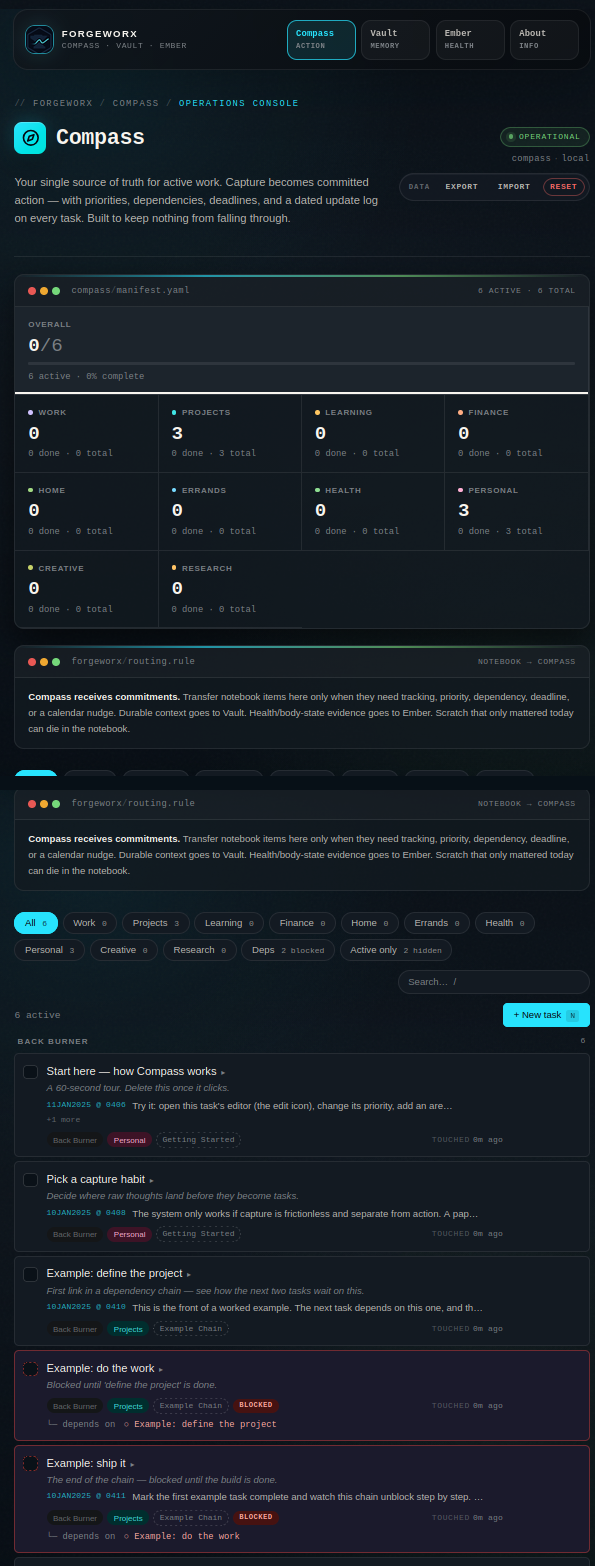
- Compass — Action layer. Tasks with deadline-derived priority tiers, dependency tracking, recurring work with sleep/wake, and tokenized search.
- Vault — Memory layer. SOPs, research, plans, and durable context. Timestamped, categorized, searchable, and review-scheduled.
- Ember — Health layer. Daily routines, physical tracking, weekly structure, and failure-safe logging so a failed write is never silent.
Everything that made Norn personal has been removed.
Everything that made it work has been kept.
The categories are generic. The naming is neutral. The setup documentation assumes nothing about who you are or how you work.
ForgeWorx is not a system you adopt.
It is a foundation you adapt.
The same idea now appears in the new TekForge Architecture surface: publish the transferable engineering model without publishing the private operational blueprint. ForgeWorx follows that rule at the application layer. The reusable boundaries are public; the operator-specific state stays private.
The notebook did not change
This is the part that is easiest to miss.
The app got better.
The notebook stayed the same.
That is not a limitation.
That is the design.
Compass receives commitments.
It does not receive raw capture.
The notebook handles fragments, half-thoughts, interruptions, and the daily mess.
Compass receives the things that have already been decided:
- This needs to happen.
- It belongs here.
- It has these dependencies.
That boundary is what keeps the task layer clean.
Compass receives commitments. The notebook receives everything else.
It scales down too
Later, the same architecture proved it could scale down.
I used it to build a stripped-down system for someone else: Duties.
He did not need a full productivity bundle.
He needed a daily operating surface, a place to plan tomorrow, a way to record how he was feeling, and something that could be deployed and maintained on the device he actually uses.
Same boundary logic.
Smaller footprint.
Built in an afternoon. Packaged as an APK. Deployed through Headwind MDM.
The interesting part was not just building it.
It was closing the loop.
A workflow idea became an application, then became a managed endpoint tool that could be updated as part of a real environment.
That is the pattern I care about: identify the workflow, build the smallest useful system, and put it where the work actually happens.
The pattern is not the app. The pattern is the boundary logic: what belongs in action, what belongs in memory, and what belongs in health.
Where it goes from here
ForgeWorx is the release.
It is intentionally stable.
The goal was never to create another constantly evolving platform. The goal was to extract the architecture that proved useful, remove the parts specific to me, and release something portable that someone else can make their own.
Norn is different.
Norn is my personal operations shell, and it will continue evolving because it is connected to my work, infrastructure, and the systems I run every day.
The next layer on top of Norn is SKALD.
Not AI making decisions.
A routing layer.
A system that reduces friction between capture, memory, and action.
That work stays inside Norn because it depends on the context Norn has accumulated over time.
ForgeWorx proves the architecture.
Norn continues exploring what happens when that architecture becomes intelligent.
The foundation is already built.
It started with five words in a notebook on a Tuesday morning.
Get ForgeWorx
ForgeWorx is free and open source. The release includes Compass, Vault, and Ember as static HTML tools that can run locally or be hosted anywhere.